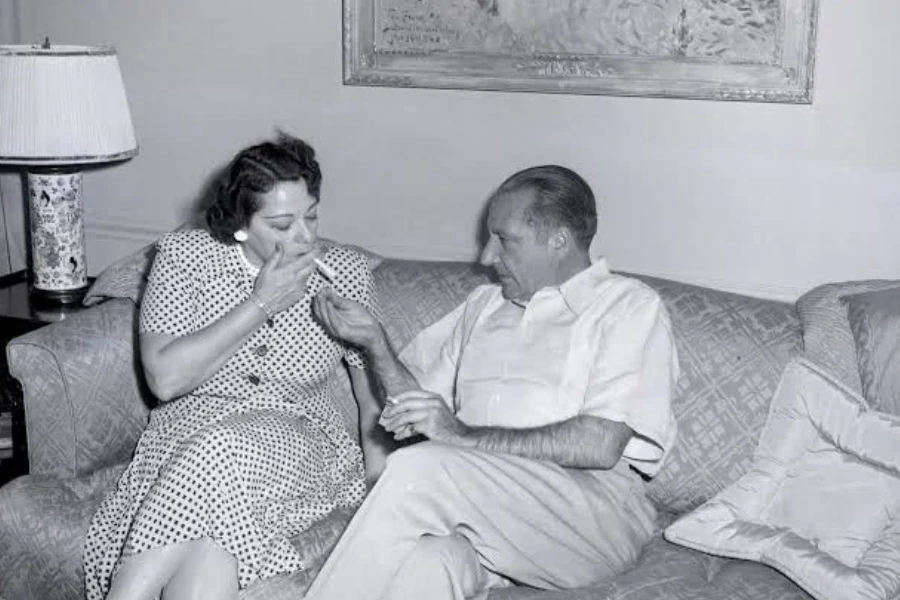
Behind nearly every major figure in American organized crime history stands someone who chose silence over spectacle. In Frank Costello’s case, that person was his wife, Lauretta Giegerman — a woman who spent more than fifty years married to one of the most powerful and feared men in twentieth-century New York, and who managed throughout that time to remain almost completely invisible to the public record.
She was not a participant in her husband’s criminal enterprise in any documented sense. She did not testify against him, seek the spotlight, or write a memoir. What she did do was stay. Through Prohibition, through the political scandals that swirled around Costello in the 1940s, through the televised Senate hearings of 1951, through a near-fatal assassination attempt in 1957, and through Costello’s gradual retreat from Mafia life in his final years — Lauretta was there.
This article covers what is actually known about Lauretta Giegerman, separating confirmed details from the considerable amount of misinformation that has accumulated around her name online.
A Note on Sources and Accuracy
Before anything else, a word of caution is necessary. Lauretta Giegerman left almost no individual documentary trace — no published interviews, no memoirs, no court testimony attributed to her by name. What exists are references in Frank Costello’s biographies and historical accounts, a Wikipedia entry on Costello that lists her as his spouse, and a small number of historical records.
As a result, a significant amount of what circulates online about Lauretta is unreliable. Different sites list her birth year as anywhere between 1894 and 1901. The marriage year appears variously as 1914, 1918, and 1927. Some sites invent children for her; others claim she faced assassination attempts personally; others fabricate a career as a “writing coach” or “digital artist” — content that is clearly generated without any factual basis.
This article relies on the sources that have established credibility: Frank Costello’s Wikipedia entry (citing the biography Uncle Frank by Leonard Katz), The Famous People biography, the Alcatraz East Museum’s historical profile, Encyclopaedia Britannica, and The Mob Museum. Where those sources agree, this article states the fact. Where they conflict or remain silent, this article says so plainly.
Who Was Lauretta Giegerman?
Lauretta Giegerman was an American woman born in Manhattan, New York, in the late nineteenth century. The most specific birth date in the available record — October 28, 1894 — comes from one biographical source, though other accounts place her birth in neighbouring years. What is consistent across sources is that she was born in New York, was Jewish by background, and grew up in the same East Harlem neighbourhood as the man she would eventually marry.
Her parents were Jacob Giegerman and Celia Giegerman. Beyond their names, nothing about her family’s circumstances, her childhood, or her education is documented in any source that can be independently verified.
She was, in short, an ordinary New York woman from a working-class immigrant community — until the man she had known since childhood became anything but ordinary.
Frank Costello: The Man She Married
To understand Lauretta Giegerman’s life, it is necessary to understand who Frank Costello was — because for most of the twentieth century, the two were inseparable in the eyes of those who knew them.
Frank Costello was born Francesco Castiglia on January 26, 1891, in Cassano allo Ionio, in the Calabria region of southern Italy. His family emigrated to the United States when he was four years old and settled in East Harlem, then one of New York’s most densely packed immigrant neighbourhoods. He left school early and gravitated toward the street gangs that were a fixture of the neighbourhood, accumulating a series of arrests for assault and weapons offences between 1908 and 1917.
After his release from jail in 1917, having decided to give up carrying a gun — a decision he maintained for the rest of his life — he reconnected with a childhood acquaintance: Lauretta Giegerman, who was the sister of a close friend. According to the biography Uncle Frank by Leonard Katz, the relationship developed quickly. In 1918, the two married.
By that point, Costello was already moving in the direction of organized crime. He changed his name legally from Castiglia to Costello in 1916, partly to sound less Italian at a time when Italian immigrants faced significant discrimination in the United States. He began working with the Morello crime family under boss Ciro Terranova almost immediately after the wedding.
Lauretta married a man who, within a decade, would become one of the most powerful figures in American criminal history.
Marriage to a Mob Boss: What Life Actually Looked Like
Frank Costello’s rise through the ranks of New York organized crime was not the flamboyant, violent kind associated with figures like Al Capone. Costello was a different type of criminal figure — cerebral, politically connected, and determined to avoid unnecessary violence. He preferred to resolve disputes through negotiation rather than force, which is how he earned the nickname “The Prime Minister of the Underworld.”
That nickname captures something important about how Costello operated — and by extension, how Lauretta’s life was shaped. He was not a figure who attracted constant gunfights or police raids. He was a figure who attended dinners with politicians, socialised with businessmen, and operated through influence rather than intimidation. His world was, in many respects, dressed up to look respectable.
During Prohibition — which lasted from 1920 to 1933 — Costello built significant wealth through bootlegging, working alongside figures including Meyer Lansky and Bugsy Siegel. After Prohibition ended, he shifted his operations toward gambling, controlling slot machine operations across New York and later acquiring interests in Las Vegas casinos. He became a central figure in the Luciano crime family after Lucky Luciano was imprisoned in 1936, and when Vito Genovese fled to Italy in 1937, Costello effectively became the boss of what would later be renamed the Genovese crime family, a position he held from 1938 to 1957.
Throughout this period, Lauretta lived in an apartment on Central Park West — an address that spoke to Costello’s success in projecting legitimacy. They had no children. This is one of the few personal details about their marriage that is consistently confirmed across reliable sources.
What Lauretta knew about her husband’s business, how she felt about it, whether she ever expressed concern or disagreement — none of that is documented. She left no public record of her inner life. What the historical record does show is simply that she remained. She was still his wife when the world came for him.
The Kefauver Hearings: 1951
If there was one moment when the life Lauretta Giegerman had built — the comfortable apartment, the respectable surface — was most clearly exposed to public scrutiny, it was 1951.
That year, the United States Senate’s Special Committee to Investigate Crime in Interstate Commerce, chaired by Tennessee Senator Estes Kefauver, came to New York. The hearings were broadcast live on television — a medium that was still new to most Americans. An estimated 30 million people tuned in to watch. What they saw were organized crime figures, including Frank Costello, called to testify about their activities.
Costello made an unusual arrangement with the committee: he refused to allow his face to be shown on camera. As a result, the television audience saw his hands — fidgeting, twisting, tightening — while his raspy voice answered questions, deflected others, and eventually led him to walk out of the hearings entirely. He was subsequently found in contempt of the Senate and imprisoned for a period.
The television footage of those hands became one of the most iconic images of American organized crime. Marlon Brando later said he studied Frank Costello’s voice and mannerisms when developing the character of Vito Corleone for The Godfather — a connection that cemented Costello’s place in popular culture long after his death.
For Lauretta, the Kefauver hearings meant that her husband — and by extension their life together — was now a subject of nationwide public discussion in a way that had never been the case before. The hearings led directly to Costello’s conviction for tax evasion in 1952 and a subsequent prison sentence, from which he was released in 1954 and then re-sentenced before being released again in 1957.
The Assassination Attempt: May 2, 1957
The most dramatic single event in the final chapter of Frank Costello’s mob career came on the evening of May 2, 1957.
Costello had just returned to his Manhattan apartment building — the Majestic on Central Park West — when a large man in the lobby called out to him. As Costello turned, the man fired a single shot. The bullet grazed the side of Costello’s head, leaving a wound that bled heavily but did not penetrate the skull. Costello survived.
The shooter was Vincent Gigante, a small-time mobster acting on the orders of Vito Genovese, who had returned from Italy and wanted to reclaim leadership of the crime family. Genovese believed — correctly — that ordering Costello’s death was the most direct path to that goal. What he had not counted on was that Costello would survive.
Gigante was arrested and tried, but Costello declined to identify him as the shooter, and Gigante was acquitted. The Mafia Commission — the governing body of the major American crime families — met and reached a settlement: Costello would retire from active leadership, keep the income from his existing rackets, and step aside for Genovese. Costello agreed.
That decision — to accept retirement rather than pursue revenge — was entirely consistent with who Frank Costello had always been. And it meant that Lauretta’s husband would now be at home rather than running an empire.
The two moved to an estate on Long Island, where Costello spent his final years gardening, meeting occasionally with younger mob figures who sought his counsel, and living the quiet life of a retired man who happened to have been one of the most powerful criminals in American history.
Later Life and Death
Frank Costello died on February 18, 1973, of a heart attack, at Doctors Hospital in New York City. He was 82 years old. He was buried at Saint Michael’s Cemetery in Queens, New York.
He and Lauretta had been married for 55 years.
What happened to Lauretta after 1973 is not clearly documented. One biographical source states that she died sometime after her husband, with one source suggesting 1973 as a possible death year, while others suggest she survived him by some years. Given that she was born in approximately 1894 and Frank died in 1973, she would have been nearly 80 at the time of his death, and it is reasonable to conclude she died in the 1970s or early 1980s — though no verified date has been established in any source consulted for this article. Claims that she died in 1992 at age 95 appear on some sites without any cited source and should be treated as unverified.
What is consistent across sources is that after Frank’s death, Lauretta remained out of the public eye entirely — much as she had throughout her life.
Lauretta Giegerman’s Place in the Costello Story
It would be easy, and wrong, to dismiss Lauretta Giegerman as simply a background figure in her husband’s story. She was a human being who made a choice — to marry a man she had known from childhood, and to stay with him through circumstances that would have tested almost anyone’s resolve.
She was present for more than half a century of American history — from the Prohibition era through World War II, the postwar boom, the era of televised congressional hearings, and into the early 1970s. She shared an apartment with a man who was simultaneously dining with judges and politicians while overseeing one of the most powerful criminal organizations in the country. She watched her husband be hauled before a Senate committee on live national television. She was there the night someone tried to kill him.
And through all of it, she said nothing publicly. No interviews. No book. No account of what it was actually like.
That silence is itself a statement — though what it means, only she knew.
Frequently Asked Questions
Who was Lauretta Giegerman?
She was the wife of Frank Costello, the New York mob boss and head of the Luciano crime family (later the Genovese crime family) from the late 1930s to 1957. Born in Manhattan in approximately 1894, she married Costello in 1918 and remained his wife until his death in 1973.
How did Lauretta Giegerman and Frank Costello meet?
She was the sister of a close friend of Costello’s from their shared East Harlem neighbourhood. According to the biography Uncle Frank by Leonard Katz, they reconnected after Costello’s release from jail in 1917 and married the following year.
Did Lauretta and Frank Costello have children?
No. This is consistently confirmed across reliable sources including Wikipedia and The Famous People. They had no children.
Was Lauretta Giegerman involved in Frank Costello’s criminal activities?
There is no documented evidence in any reliable source that Lauretta participated in or had any formal role in her husband’s criminal operations. She is consistently described as maintaining a private, domestic life.
When did Lauretta Giegerman die?
The precise date is not confirmed in any reliably sourced record. She survived Frank Costello, who died in February 1973. Beyond that, no verified death date has been established.
Why is Lauretta Giegerman’s birth year listed differently across different sites?
Because primary source documentation for her life is extremely limited, and different sites have made different guesses or cited unverified sources. The most specific date in the available record is October 28, 1894, from one biographical source, but this has not been independently verified.
Conclusion
Lauretta Giegerman Costello is one of those figures in American history who matters not because of what she did, but because of what she witnessed and what she chose not to say. She spent more than five decades married to a man at the centre of American organized crime — a man whose voice inspired a fictional character that became one of cinema’s most enduring icons — and left almost no trace of her own perspective on any of it.
That kind of deliberate privacy is rare in any era, and almost unimaginable today. Whatever her reasons — loyalty, caution, love, resignation, or some combination of all of them — Lauretta Giegerman made a choice to remain in the background of a story that the rest of America was fascinated by. She did so successfully, for the entirety of her adult life.
For readers interested in exploring the broader history of organized crime in New York, the National Crime Syndicate’s documented history at Encyclopaedia Britannica provides a reliable overview, and The Mob Museum in Las Vegas maintains a substantial archive of materials on figures including Frank Costello.
For more profiles of people who shaped history from behind the scenes, visit The Athens Magazine homepage. You may also be interested in our piece on Bert Girigorie, whose brief time in the public eye raises similar questions about what we know and don’t know about the people adjacent to fame, or our profile of Melissa Lee Gatlin, another woman who chose privacy over public attention after a high-profile connection. And for those drawn to stories where celebrity and private life intersect in complicated ways, our piece on Zachary Hudson covers similar territory.