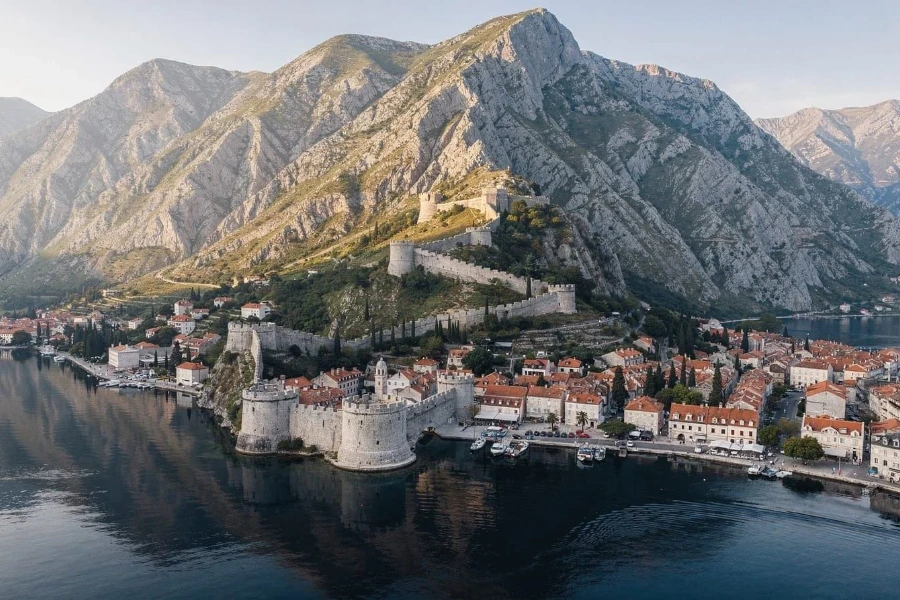
Kotor is a walled medieval town at the end of a deep, dramatic bay on Montenegro’s Adriatic coast, and it is one of the most scenic places in the Balkans. In Latvian it is written Kotora, Melnkalne, and in Montenegrin it is simply Kotor. Whatever you call it, the appeal is the same: a maze of stone streets, Venetian palaces and churches below steep mountains, with fortress walls climbing the slope behind.
This guide covers what Kotor is, why it earned UNESCO status, what to do in the old town and around the bay, and the practical details most visitors want before they book: when to go, how to get there, where to eat and how to avoid the worst crowds.
Why Kotor Is Worth Visiting
Kotor sits inside the Bay of Kotor, often called Europe’s southernmost fjord. Strictly speaking, geologists describe it as a drowned river canyon rather than a glacial fjord, but the effect is similar: steep, dark mountains drop into calm green water, and small towns cling to the shoreline.
The old town itself is compact, which is part of its charm. You can walk across it in a few minutes, but you will want hours, because every lane opens into a small square, a church or a view. The place has been inhabited for more than two thousand years, and it still feels lived-in rather than preserved under glass. People hang laundry from windows, cats sit on church steps, and cafés fill the squares in the evening.
A Short History of Kotor
Kotor’s story is tied to the sea and to whoever controlled it. The town grew as a trading and seafaring port, and its fortifications were built and extended over many centuries. According to one regional guide, the walls were built into the steep hillside by the Byzantines and Venetians between the ninth and twelfth centuries, while another source notes that construction continued to the fourteenth century, with additions made as late as the nineteenth.
The most formative period was Venetian rule, which lasted from 1420 to 1797. That era shaped the stone architecture visitors see today: tall townhouses, loggias, small piazzas and decorative doorways. After Venice fell, the Austrian Habsburgs ruled the bay for more than a century until the end of the First World War, when the region became part of Yugoslavia. Montenegro became an independent state in 2006.
In 1979, a powerful earthquake damaged the region. The same year, UNESCO inscribed the area as the Natural and Culturo-Historical Region of Kotor, partly to help protect it. Kotor’s fortifications are also part of a separate UNESCO listing, the Venetian Works of Defence.
What to See in Kotor Old Town
The Sea Gate and main squares
Most visitors enter through the Sea Gate, the main entrance facing the bay, which gives you an immediate sense of the town’s maritime past. Just inside is the Square of Arms, the largest open space in the old town, surrounded by cafés and the clock tower.
St Tryphon’s Cathedral
The Roman Catholic Cathedral of St Tryphon, dating back to the twelfth century, is the best-known landmark and the town’s spiritual centre. Its two bell towers are unmistakable on the skyline, and the interior holds religious art and relics tied to Kotor’s patron saint.
The Maritime Museum
Kotor was a seafaring town for centuries, and the Maritime Museum explains how. It is housed in an eighteenth-century palace and tells the story of the town’s navigators, trade and naval history. It is a good choice for a hot afternoon or a rainy day, and it gives context for everything else you will see.
Churches, piazzas and back streets
Kotor has a mix of Catholic and Orthodox churches, including the Orthodox Church of St Nicholas, a centre of the Orthodox community. The best way to explore is to wander without a fixed plan. The old town is a maze, and getting lost for a few minutes is part of the experience. Side streets are quieter than the main squares, especially early in the morning.
Climbing to San Giovanni Fortress
The signature activity in Kotor is the walk up the city walls to the fortress of St John, known locally as San Giovanni, high above the town. Many guides describe a staircase of about 1,350 steps, and the total length of the walls is around five kilometres.
A few tips make the climb more enjoyable:
- Go early or late. Midday in summer is hot and busy. Sunrise and the last hour before sunset are quieter and cooler.
- Bring water and proper shoes. The stone steps can be uneven and slippery.
- Take your time. There are viewpoints and small churches on the way, so you do not need to rush to the top.
- Check ticket rules before you go. The walls charge an entrance fee, and prices and opening hours change, so confirm the current details locally or on the official Montenegro tourism website.
The view from the top shows the whole bay, the red-tiled roofs of the old town and the mountains behind, and it is easily the best photograph you will take in Kotor.
Exploring the Bay of Kotor
Kotor is only one part of the bay, and it is worth leaving the old town for at least a day to see the rest.
Perast
Perast is a small baroque town on the water, about a short drive from Kotor. It is known for its stone palaces and the bell tower of the Church of St Nicholas, which reaches around 55 metres and offers views over the bay. You can read more on Perast’s Wikipedia page.
Just offshore are two small islands, including Our Lady of the Rocks, a church built on an artificial island. Small boats run from Perast and are usually quick and inexpensive.
Risan, Prčanj and Herceg Novi
Risan is one of the oldest settlements on the bay and is known for a Roman mosaic depicting Hypnos, the god of sleep. Prčanj is a quiet village with a large baroque church and old captains’ houses. Herceg Novi, near the bay’s entrance, has fortresses and a lively seafront and is a convenient stop if you are travelling to or from Croatia.
A boat trip around the bay
If you want a relaxed day, a boat trip lets you see the coastline, small chapels and villages from the water. Many tours combine Perast, Our Lady of the Rocks and a swim stop. For a longer overview of what the region offers, this guide to the Bay of Kotor gives useful context.
Day Trips From Kotor
Kotor works well as a base for exploring the rest of Montenegro:
- Lovćen National Park. A famous road with dozens of hairpin bends climbs from Kotor into the mountains, ending at the mausoleum of Petar II Petrović-Njegoš, the poet-ruler revered in Montenegro. The summit stands at about 1,749 metres and gives a wide view over the country. The drive is memorable but demanding, so take it slowly.
- Njeguši. A traditional village on the way up, known for smoked ham and cheese.
- Cetinje. The old royal capital, with museums and a quiet, historic centre.
- Budva. A lively resort town on the coast with beaches and nightlife, roughly half an hour away by car.
- Lake Skadar. A large lake and national park with birdlife and boat trips.
- Dubrovnik, Croatia. Often done as a long day trip, though border crossings can add time in summer.
Best Time to Visit Kotor
The best months are usually May, June, September and early October. The weather is warm, the sea is swimmable and the crowds are more manageable.
July and August are hot and busy. Kotor is a popular cruise port, and when several ships arrive on the same day, the old town fills up quickly, particularly between mid-morning and mid-afternoon. If you are visiting in summer, plan your sightseeing for early morning or evening and spend the middle of the day at the beach or on a boat.
Winter is quiet and often rainy, with some restaurants and tours closed, but the town is peaceful and cheaper. Rain is common in the bay, especially in autumn and winter, so bring a waterproof jacket.
How to Get to Kotor
By air. The closest airport is Tivat, just a short drive from Kotor, with seasonal and year-round connections to a number of European cities. Podgorica, the capital, has a larger airport and is roughly an hour and a half away by road. Many travellers also fly into Dubrovnik in Croatia and cross the border, which takes about two hours depending on traffic and queues.
By road. Buses link Kotor with Podgorica, Budva, Dubrovnik and other cities. Renting a car gives you flexibility for the bay and the mountains, but parking in and near the old town is limited and can be expensive in summer.
By sea. Cruise ships dock close to the old town, so cruise passengers arrive right at the Sea Gate.
Entry rules. Montenegro is not a member of the European Union, and entry requirements depend on your nationality. Rules, including any digital border systems, can change, so check the official government or consular guidance for your passport before you travel.
Where to Stay
Staying inside the old town is atmospheric, but it can be noisy at night and may involve carrying luggage along stone lanes. Many visitors prefer Dobrota, a stretch of waterfront just north of the old town, or smaller bay villages such as Prčanj, where you can find quieter accommodation with sea views. Prices rise sharply in July and August, so book early if you are travelling in peak season.
What to Eat and Drink
Montenegrin food mixes Mediterranean and Balkan influences. Common dishes include:
- Black risotto, coloured with cuttlefish ink, widely served along the coast.
- Grilled fish and seafood, especially sea bass, squid and prawns.
- Njeguši prosciutto and cheese, from the mountain village of the same name.
- Burek and grilled meats, common across the Balkans.
- Local wine, especially the red Vranac and the white Krstač.
Restaurants in the old town are convenient but can be pricier. Walking a few minutes along the waterfront in Dobrota or Prčanj often brings better value and views.
Practical Tips for a Smooth Trip
- Currency: Montenegro uses the euro (€) as its official currency, despite not being a member of the European Union.
- Walking. Cobblestones and steps are everywhere, so comfortable shoes matter more than fashionable ones.
- Sun and heat. Summer afternoons are intense. Carry water and a hat.
- Cats. Kotor is famous for its stray cats, and you will see them on walls and doorsteps.
- Avoid the midday rush. The best light, and the fewest people, are early morning and early evening.
- Carry some cash. Cards are widely accepted, but small cafés and market stalls sometimes prefer cash.
A Sample Two-Day Itinerary
Day one: Walk the old town in the morning, visit the cathedral and the Maritime Museum, then eat lunch away from the main square. Climb to San Giovanni late in the afternoon for the sunset light, and have dinner in a bay-side restaurant.
Day two: Drive or take a boat to Perast, visit Our Lady of the Rocks, and spend the afternoon swimming or relaxing. Alternatively, take the Lovćen road in the morning and return to the bay for a late lunch.
Frequently Asked Questions
Is Kotor worth visiting if I only have one day?
Yes, the old town and the fortress climb can be done in a day, but two days lets you add Perast and a swim.
Is Kotor a fjord?
It is commonly called one, but it is technically a ria, or drowned river canyon, though the scenery looks like a fjord.
When was Kotor named a UNESCO site?
In 1979, as the Natural and Culturo-Historical Region of Kotor.
How many steps lead to the fortress?
Roughly 1,350, according to several travel guides.
Is Kotor crowded?
In summer, especially on cruise-ship days, yes. Spring and early autumn are calmer.
Do I need a car?
Not for the old town, but a car or organised tour helps for Lovćen and the wider bay.
What currency is used?
The euro.
Final Thoughts
Kotor rewards visitors who slow down. Spend a morning inside the old walls, climb the fortress for the view, and then take time on the water, in Perast or in a quiet bay village, to see why this small stretch of coast has attracted travellers for centuries. Go in spring or early autumn if you can, and leave room in the itinerary for wandering.
For more articles and guides, visit The Athens Magazine homepage or browse the Guide section.